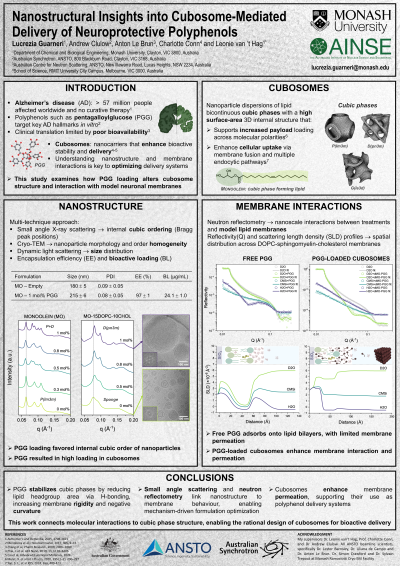
Nanostructural Insights into Cubosome-Mediated Delivery of Neuroprotective Polyphenols
Andrew Clulow – Senior Beamline Scientist, BioSAXS, The Australian Synchrotron; Anton Le Brun – Instrument Scientist (Neutron Reflectometry), ANSTO; Charlotte Conn, PhD – Professor, School of Science, RMIT University; Leonie van't Hag, PhD – Senior Lecturer, Chemical and biological engineering, Monash university
PhD candidate Monash university Melbourne, Victoria, Australia
Introduction: Alzheimer’s disease (AD) is a prevalent neurodegenerative disorder for which treatments fail to alter disease progression1. Polyphenols, such as pentagalloylglucose (PGG), have neuroprotective potential2 but poor bioavailability3. Lipid nanoparticles, including cubosomes, offer a promising platform to improve bioactive stability and delivery4,5. Both nanoparticle nanostructure and interactions with model membranes are essential to guide the design of cubosomes for effective polyphenol delivery. This study aims to investigate the impact of PGG loading on cubosome nanostructure and the interactions of PGG-loaded cubosomes with lipid bilayers mimicking neuronal membranes.
Learning Objectives:
Describe how polyphenols alter cubosome nanostructure and phase behaviour.
Apply SAXS, SANS, and neutron reflectometry to understand structure and improve formulation.
Explain how cubosome interact with lipid bilayers mimicking biological membranes.