Chitosan-Coated Liposomes Reduce Tumor Growth in Pancreatic Adenocarcinoma Model
Mateus Silva – PhD student, Universidade de Brasília; Davi Ferreira – Professor, Universidade de Brasília; Tais Gratieri – Professor, Universidade de Brasília; Marcilio Cunha-Filho – Professor, Universidade de Brasília; Moacyr Rêgo – Professor, Universidade Federal de Pernambuco; Miguel Merlos Rodrigo – Professor, Mendel Univesity
Professor Universidade de Brasília (UnB) Brasília, Distrito Federal, Brazil
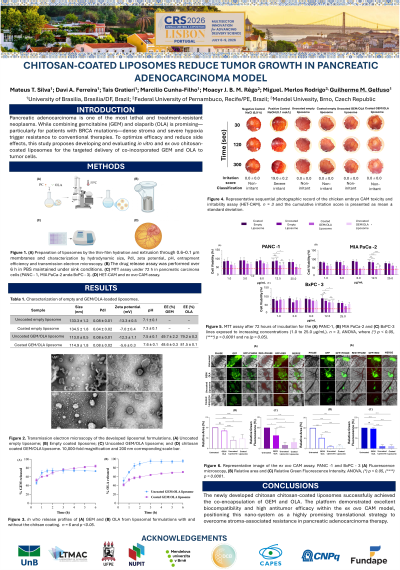
Introduction: Pancreatic adenocarcinoma is one of the most lethal and challenging to treat neoplasms (1). The combination of gemcitabine (GEM) and olaparib (OLA) has demonstrated promise as an alternative treatment for this disease (2), particularly in patients with BRCA gene mutations (3). With the goal of targeting drug delivery to the site of action, improving treatment efficacy, and reducing side effects, this study proposes developing and evaluating in vitro the feasibility of chitosan-coated liposomes for the delivery of co-entrapped GEM and OLA to tumor cells.
Learning Objectives:
Understand whether gemcitabine and olaparib are stable in liposomes and whether they do not interact with each other.
Develop and characterize chitosan-coated liposomes as an alternative for the treatment of pancreatic cancer.
Evaluate whether liposomes decrease the viability of pancreatic cancer cells, and are effective in reducing tumors.