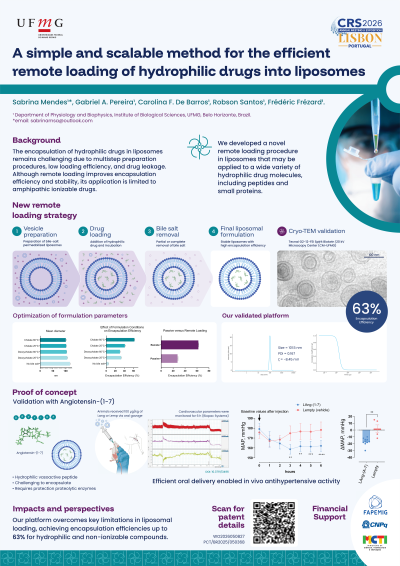
(433) A simple and scalable method for the efficient remote loading of hydrophilic drugs into liposomes
Carolina De Barros, MSc – PhD student, Dept. Physiology and Biophysics, Universidade Federal de Minas Gerais; Sabrina Mendes, Ph.D. – Post-doc, Dept. Physiology and Biophysics, Universidade Federal de Minas Gerais; Gabriel Pereira, B.M. – undergraduate student, Dept. Physiology and Biophysics, Universidade Federal de Minas Gerais; Robson Santos, Ph.D. – Full professor, Dept. Physiology and Biophysics, Universidade Federal de Minas Gerais
Postdoctoral Researcher - Founder and CEO - LipidSolutions UFMG, Belo Horizonte, Brazil
Introduction: Preparing liposomal formulations of hydrophilic drugs is challenging because it requires a multiple-step procedure and often results in low drug loading and drug leakage. Remote drug loading into preformed liposomes represents a major advance over the passive loading methods, resulting in high efficiency and stability of drug encapsulation. However, it is restricted to amphipathic ionizable drugs. The purpose of this study was to develop a novel remote loading procedure in liposomes that may be applied to a wide variety of hydrophilic drug molecules, including peptides and small proteins.
Learning Objectives:
Develop new liposomal formulations for hydrophilic drugs, using a simple and efficient remote loading method
Identify applications of liposomes for the non-invasive administration of hydrophilic peptides