(416) Hydroxyl labelling and analysis of poly(lactide-co-glycolide) polymers by napthyl isocyanate and limitations
Justin Hadar – Scientist, Akina, Inc.; Young Jhon – Senior Chemist, Food and Drug Administration; Haesun Park – Vice President, Akina, Inc.; Kinam Park – President, Akina, Inc.; Christine Plavchak – Pharmaceutical Scientist, Food and Drug Administration; Sarah Skidmore – Scientist, Akina, Inc.; William Smith – Research Scientist, Food and Drug Administration; Yang Wang – Deputy Division Director, Food and Drug Administration; Deyi Zhang – Senior Chemist, Food and Drug Administration; Yuan Zou – Scientist, Food and Drug Administration
General Manager Akina, Inc. West Lafayette, Indiana, United States
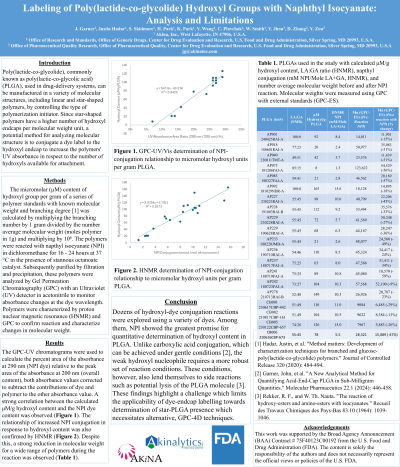
Introduction: Poly(lactide-co-glycolide), commonly known as poly(lactic-co-glycolic acid) (PLGA), used in drug-delivery systems, can be manufactured in a variety of molecular structures, including linear and star-shaped polymers, by controlling the type of polymerization initiator. Since star-shaped polymers have a higher number of hydroxyl endcaps per molecular weight unit, a potential method for analyzing molecular structure is to conjugate a dye label to the hydroxyl endcap to increase the polymers' UV absorbance.
Learning Objectives:
Understand Techniques for end-cap determination of PLGA.
Appreciate the complexities of analysis inherent to polymers in general and PLGA specifically.
Conceptualize the relationship between analytical data and the polymer being analyzed.