Lipid nanoparticles for the treatment of inflammatory lung cancer in 3D and organ-on-chip models
Shameer Pillarisetti – Post-doctoral fellowship, Pharmacy, University of Chieti - Pescara "G. d'Annunzio"; Roberto Plebani – Assistant Professor, Department of Medical, Oral and Biotechnological Sciences, University of Chieti - Pescara "G. d'Annunzio"; Luigi Ciriolo – PhD student, Health Sciences, University of Catanzaro "Magna Graecia"; Nicola d'Avanzo – Assistant Professor, Clinical and Experimental Medicine, University of Catanzaro "Magna Graecia"; Rosanna Alfieri – PhD student, Pharmacy, University of Chieti - Pescara "G. d'Annunzio"; Piero Di Carlo – Full Professor, Department of Innovative Technologies in Medicine and Dentistry, University of Chieti - Pescara "G. d'Annunzio"; Massimo Fresta – Full Professor, Health Sciences, University of Catanzaro "Magna Graecia"; Mario Romano – Emeritus Professor, Department of Medical, Oral and Biotechnological Sciences, University of Chieti - Pescara "G. d'Annunzio"
Associate Professor University of Chieti - Pescara "G. d'Annunzio" Chieti, Abruzzi, Italy
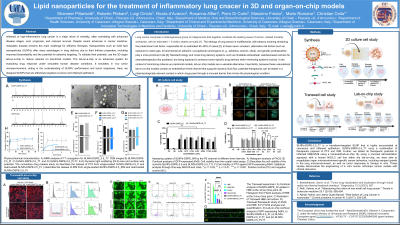
Introduction: Lipid nanoparticles are currently used for many therapeutic treatment in anticancer therapy. Lung cancer has recently emerged as a relevant cancer diseases affecting patients and it has high incidence and mortality, particularly if associated with local inflammation of pulmonary tissue. The resulting inflammation in lung tissue may increase the development and progression of lung cancer with a significant decrease of patient quality of life. The aim of this study is the synthesis and characterization of indomethacin and paclitaxel-loaded lipid nanoparticles and their tests in 3D and organ-on-chip models.
Learning Objectives:
Indomethacin and Paclitaxel lipid nanoparticles have biopharmaceutical properties for anticancer therpay.
Lipid nanoparticles have nanometer scale and control the delivery of both co-loaded drugs favoring tumor uptake.
Therapeutic lipid nanoparticles have precise effectiveness in 3D and organ-on-chip models of lung cancer.