Manufacturing and Process Scale-Up

Sara Bordonhos Cardoso, MSc
PhD student
1 Research Institute for Medicines (iMed.ULisboa), Faculty of Pharmacy, Universidade de Lisboa, Avenida Prof. Gama Pinto, 1649-003 Lisboa, Portugal, Lisbon, Portugal.; 2 Faculty of Pharmacy, Universidade de Lisboa, Avenida Prof. Gama Pinto, 1649-003 Lisboa, Portugal, Lisbon, Portugal., Portugal
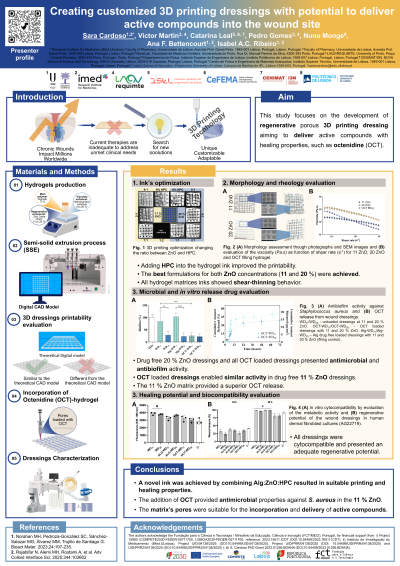
When the healing process of a wound is disrupted, chronic wounds may develop, affecting millions of patients worldwide each year (1). To overcome this issue, three-dimensional (3D) printing technology can be explored to produce 3D dressings, presenting the advantage of creating unique and customized systems tailored to the specific needs of each patient (2). Thus, our study focuses on the development of regenerative porous 3D printing dressing aiming to deliver active compounds with healing properties, such as octenidine (OCT).