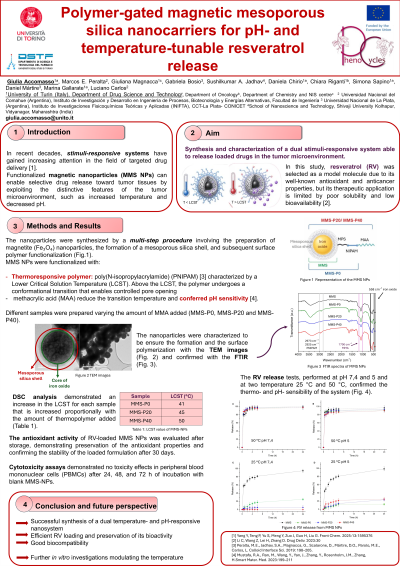
Polymer-gated magnetic mesoporous silica nanocarriers for pH- and temperature-tunable resveratrol release
Marcos Emanuel Peralta – assistant professor, Universidad Nacional del Comahue (Argentina), Instituto de Investigación y Desarrollo en Ingeniería de Procesos, Biotecnología y Energías Alternativas, PROBIEN (CONICET-UNCo), Facultad de Ingeniería; Giuliana Magnacca – Associate professor, University of Turin (Italy), Department of Chemistry and NIS Centre; Gabriela Bosio – assistant professor, Universidad Nacional de La Plata, (Argentina), Instituto de Investigaciones Fisicoquímicas Teóricas y Aplicadas (INIFTA), CCT-La Plata- CONICET; A Jadhav Sushilkumar – assistant professor, School of Nanoscience and Technology, Shivaji University Kolhapur, Vidyanagar, Kolhapur, Maharashtra, India; Daniela Chirio – Associate professor, University of Turin (Italy), Department of Drug Science and Technology; Elena Peira – Associate professor, University of Turin (Italy), Department of Drug Science and Technology; Chiara Riganti – Full professor, University of Turin (Italy), Department of Oncology; Simona Sapino – Research Technician, University of Turin (Italy), Department of Drug Science and Technology; Daniel Mártire – Professor, Universidad Nacional de La Plata, (Argentina), Instituto de Investigaciones Fisicoquímicas Teóricas y Aplicadas (INIFTA), CCT-La Plata- CONICET; Marina Gallarate – Associate professor, University of Turin (Italy), Department of Drug Science and Technology; Carlos Luciano – Independent researcher, Universidad Nacional del Comahue (Argentina), Instituto de Investigación y Desarrollo en Ingeniería de Procesos, Biotecnología y Energías Alternativas, PROBIEN (CONICET-UNCo), Facultad de Ingeniería
Introduction: Magnetic nanoparticles (NPs)have attracted significant attention in biomedicine due to their multiple applications [1]. Magnetic mesoporous silica NPs (MMS NPs) were investigated as carriers for resveratrol (RV), a natural compound with antioxidant and anticancer activities limited by poor solubility and low bioavailability [2]. To address these limitations, MMS NPs were functionalized with a thermoresponsive poly(N-isopropylacrylamide) (PNIPAM)-based polymer [3]. Adding methacrylic acid (MAA) reduced the transition temperature and conferred pH-sensitivity [4]; enabling a dual stimuli-responsive system that might be exploited for controlled RV release.
Learning Objectives:
Describe the role of thermoresponsive polymers and methacrylic acid in creating dual stimuli-responsive systems
Evaluate nanoparticle-based systems to enhance the therapeutic effect of resveratrol reducing its limitations