Drug-eluting melt-spun liquid-core fibers for hernia meshes
Markus Rottmar – Group Leader, Cell-/Tissue Material Interactions, Swiss Federal Laboratories for Materials Science and Technology (Empa); Qun Ren Zulian – Group Leader, Bacteria and Materials Interactions, Swiss Federal Laboratories for Materials Science and Technology (Empa); Rudolf Hufenus – Deputy Head of Laboratory, Polymers & Processing, Swiss Federal Laboratories for Materials Science and Technology (Empa); Edith Perret – AD interim Gruppenleiterin, Polymers & Processing, Swiss Federal Laboratories for Materials Science and Technology (Empa)
PostDoc Swiss Federal Laboratories for Materials Science and Technology (Empa) St. Gallen, Sankt Gallen, Switzerland
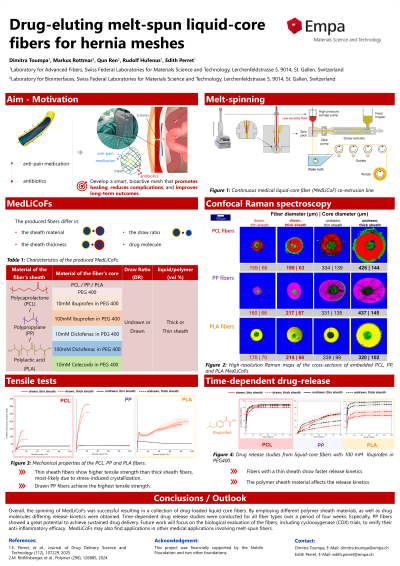
Introduction: Hernia repair meshes are globally used in over 20 million surgeries annually. Despite widespread adoption of polypropylene-based meshes, up to 20% of patients experience chronic pain or surgical site infections after implantation. These complications are often linked to inadequate local drug concentrations from systemic treatments or adverse tissue responses to the mesh. Conventional drug-loaded fibers suffer from burst release, limited drug loading, and poor mechanical performance. Here we propose a new methodology for drug loading on fibers using melt-spun liquid-core fiber technology (1-2).
Learning Objectives:
Describe how liquid-core fiber design parameters control drug release in hernia meshes.
Compare the effects of polymer sheath materials on fiber mechanics and drug stability.
Evaluate in vitro drug release profiles and bioactivity from melt-spun implantable fibers.