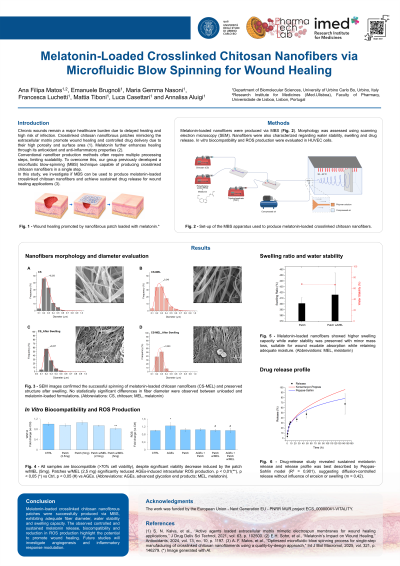
Melatonin-loaded crosslinked chitosan nanofibers via microfluidic blow spinning for wound healing
Emanuele Brugnoli – Master Student, Università degli Studi di Urbino Carlo Bo; Maria Gemma Nasoni – Researcher, Università degli Studi di Urbino Carlo Bo; Francesca Luchetti – Associate Professor, Università degli Studi di Urbino Carlo Bo; Mattia Tiboni – Postdoctoral researcher, Università degli Studi di Urbino Carlo Bo; Luca Casettari – Full Professor, Università degli Studi di Urbino Carlo Bo; Annalisa Aluigi – Associate Professor, Università degli Studi di Urbino Carlo Bo
PhD student Università degli Studi di Urbino Carlo Bo, Italy
Introduction: Chronic wounds remain a major healthcare burden due to delayed healing and high risk of infection. Chitosan nanofibrous patches with similar extracellular matrix structure offer high porosity and surface area, supporting wound healing and controlled drug delivery [1]. Melatonin further enhances healing through its antioxidant and anti-inflammatory activity [2]. We previously established a microfluidic blow-spinning process to produce crosslinked chitosan nanofibers in a single step [3]. Thus, this study investigates the potential to use this system as a controlled melatonin delivery system to promote wound healing.
Learning Objectives:
Understand if microfluidic blow-spinning can be used to produce melatonin-loaded chitosan nanofibers in one step.
Understand if sustain drug release can be achieved using the crosslinked chitosan nanofibers.
Evaluate differences between melatonin-loaded and unloaded crosslinked chitosan nanofibers.