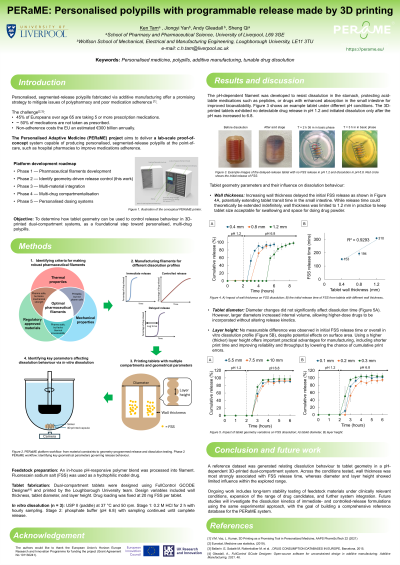
(446) PERaME: Personalised polypills with programmable release made by 3D printing
Jiongyi Yan – Postdoctoral Researcher, Wolfson School of Mechanical, Electrical and Manufacturing Engineering, Loughborough University; Andrew Gleadall – Reader, Wolfson School of Mechanical, Electrical and Manufacturing Engineering, Loughborough University; Sheng Qi – Chair in Pharmaceutics, Pharmacy and Pharmaceutical Science, University of Liverpool
Research Associate University of Liverpool Liverpool, United Kingdom
Introduction: Personalised, segmented-release polypills fabricated via additive manufacturing offer a promising strategy to mitigate issues of polypharmacy and poor medication adherence [1]. However, their implementation requires feedstock materials that balance printability, dose precision, and programmable dissolution profiles. The Personalised Adaptive Medicine (PERaME) project aims to deliver a lab-scale proof-of-concept system capable of producing personalised, segmented-release polypills at the point-of-care, such as hospital pharmacies. Feedstock materials for the PERaME system were developed to enable tailored dissolution kinetics, covering a range of release profiles.
Learning Objectives:
Understand how geometric design parameters in 3D-printed polypills influence drug release behaviour.