A Comparative Study of Nanostructured Photolyase Delivery Systems for Counteracting UV-Induced DNA Photodamage
Chiara Bufalini – Research Fellow, Department of Civil, Chemical and Environmental Engineering, University of Genoa, Genoa 16145, Italy; Roberta Campardelli – Associate Professor, Department of Civil, Chemical and Environmental Engineering, University of Genoa, Genoa 16145, Italy; Carlota de Oliveira Rangel-Yagui – Full professor, Department of Biochemical and Pharmaceutical Technology, Schoolof Pharmaceutical Sciences, University of SãoPaulo, São Paulo 05508-000, Brazil; Pier Francesco Ferrari – Assistant Professor, Department of Civil, Chemical and Environmental Engineering, University of Genoa, Genoa 16145, Italy; Paul Frederick Long – Full professor, Institute of Pharmaceutical Science, King’s College London, London SE19NQ, UK; Felipe Gonçalves – PhD student, Department of Biochemical and Pharmaceutical Technology, Schoolof Pharmaceutical Sciences, University of SãoPaulo, São Paulo 05508-000, Brazil; Patrizia Perego – Full professor, Department of Civil, Chemical and Environmental Engineering, University of Genoa, Genoa 16145, Italy; Karin Torres-Obreque – PhD, Department of Biochemical and Pharmaceutical Technology, Schoolof Pharmaceutical Sciences, University of SãoPaulo, São Paulo 05508-000, Brazil
PhD student University of São Paulo São Paulo, Sao Paulo, Brazil
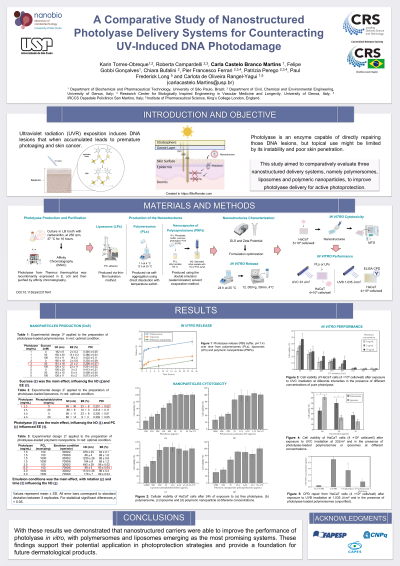
Introduction: Ultraviolet radiation (UVR) induces DNA lesions that lead to premature photoaging and skin cancer. Photolyase is a DNA repair enzyme capable of directly repairing those lesions, but its topical use might be limited by instability and poor skin penetration. This study aimed to comparatively evaluate three nanostructured delivery systems, namely polymersomes, liposomes, and polymeric nanoparticles, to improve photolyase delivery for active photoprotection.
Learning Objectives:
Observe that nanoencapsulation enhances photolyase activity;
Compare how polymersomes and liposomes are superior to PCL nanoparticles.
Determine that polymersomes are more effective for photolyase delivery.